
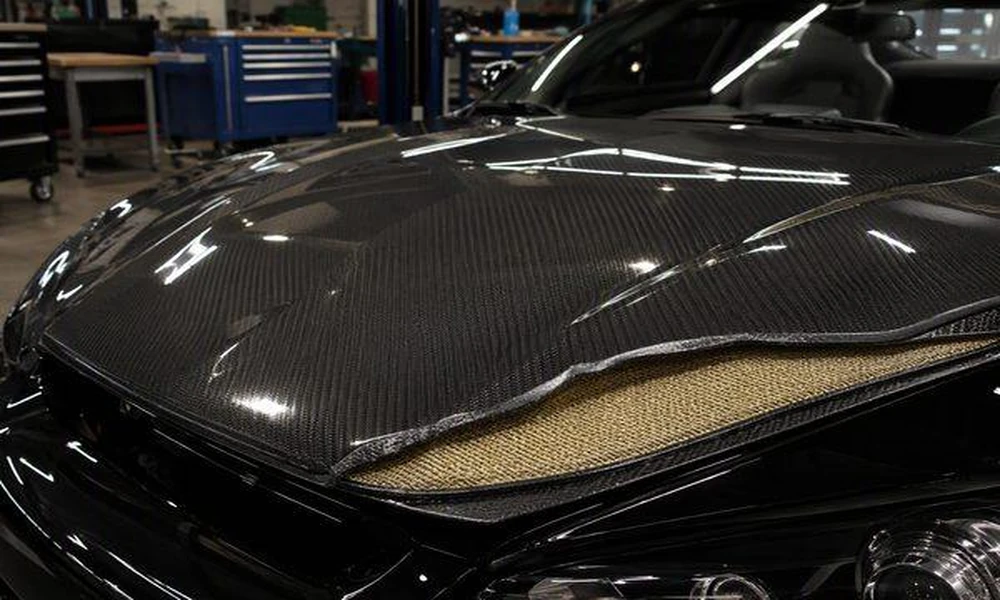
A carbon Kevlar hood on a road car. Hybrid weave is not just for race cars.
Walk through any paddock and you will see all three materials within fifty meters: plain carbon on a time-attack car, black-and-gold hybrid weave on a rally build, and maybe a full aramid skid plate underneath something that spends its life airborne. Nobody in that paddock picked their material because it was fashionable. They picked it because of how their car gets used, and how it gets hurt.
Here is how the same logic applies to your build, discipline by discipline. One warning before the tour: every discipline believes its own use case is the normal one, and every discipline is wrong. Be honest about where your car actually spends its hours, not where you imagine it spending them.
Time Attack and Circuit Racing
On a smooth circuit, the enemy is flex. A front splitter that bends at 240 km/h changes the car’s balance exactly when you need it most. Wings, splitters, and flat undertrays on track cars live and die by stiffness, and carbon fiber delivers two to six times the stiffness of aramid at the fiber level. This is carbon’s home race, and it wins it easily.
The one exception on a track car is the leading edge of the splitter, which collects rubber debris and the occasional off-track excursion. Some teams run a hybrid weave just on that sacrificial section. It adds a few grams and saves a few splitters per season.
Rally, Rallycross, and Gravel
Gravel changes everything. A rally undertray takes hundreds of stone strikes per stage, and each one is a small hammer blow. Carbon fiber under that treatment cracks, then delaminates invisibly, then lets go at the worst possible moment. Kevlar stretches before it breaks, two to four percent elongation versus about one and a half for carbon, so it absorbs strike after strike and shows you the damage instead of hiding it.
This is why full aramid skid plates exist, and why hybrid weave bumpers and undertrays dominate builds that leave the tarmac. The carbon Kevlar vs carbon fiber data makes the difference plain: same category of material, completely opposite failure behavior.
Street and Daily Driving
Street cars face a dumber set of enemies: parking blocks, steep driveways, winter sand, and shopping carts. None of them are dramatic, all of them are repeated. A hybrid front lip or bumper insert survives this life far better than pure carbon, and the gold weave does not hurt the look of a street build either.
For street aero that never touches anything, a ducktail spoiler, a roof wing, mirror caps, plain carbon remains the sensible choice. It is cheaper than hybrid and stiffer, and nothing is throwing rocks at your roof wing.
Show Cars
Show builds answer to aesthetics first. Gloss twill carbon is the classic, forged carbon is the extrovert, and the black-and-gold hybrid sits somewhere in between, with the bonus of surviving the trip to the show.
The Mixed-Material Strategy
The smartest paddock builds do not pick one material at all. They run carbon where the air is clean, hybrid where the road fights back, and aramid where the ground itself is the enemy. A typical fast street-and-track setup might be a carbon hood and wing, hybrid splitter and rockers, and an aramid undertray. Each part answers the question its location asks. The total bill ends up lower than an all-hybrid car, and the survival rate ends up higher than an all-carbon one. Materials are not a religion, they are a map.
Budget Builds vs Blank-Check Builds
Money changes the tactics but not the logic. On a tight budget, protect the one part that dies most often, usually the front lip or splitter, with a hybrid, and leave everything else plain carbon or even stock. With an unlimited budget the temptation is to hybrid everything, which mostly buys you weight and cost where nothing ever hits. The pros spend on the contact zones and save everywhere else. Copy the pros: your build sheet should look boring from the doors back, because boring back there means nothing expensive is within a stone’s reach.
A Quick Decision Table in Words
- Smooth circuit, aero load, no debris: carbon fiber, and do not overthink it.
- Gravel, rallycross, winter roads: hybrid weave on impact panels, aramid underneath.
- Street car with a low front end: hybrid on the lip and splitters, carbon elsewhere.
- Trailer queen: whatever looks best under the hall lights.
Notice what never appears on that list: the question ‘which is stronger?’ Strength depends on the direction and type of load, which is also why the carbon fiber vs aluminum conversation has the same shape. Match the material to the abuse, and you will buy parts once instead of twice. That is the whole test, and it fits in one sentence: buy for the abuse, not the brochure.